
Written by Jason Mattes
It seems like South African recyclers may have had a mixed 2025. A slightly stronger economy from 2025 Q2 onwards might have begun to be felt by recyclers, but it depends on which part of the industry is focused on. As the table below shows, non-ferrous metal prices mostly rose, but those for ferrous metals largely fell. In addition, prices for paper scrap mostly rose but were ambiguous for plastics, while exporters of plastic scrap may have been hurt by a weak British economy. On the regulatory front, the draft New National Waste Management Strategy 2026 (NWMS 2026) was published, bringing with it costs as well as some opportunities.
Selected Metal Price Movements in 2025

Looking ahead to 2026, the figure below shows that the domestic recycling industry may be able to look forward to a marginally stronger economy locally and in Sub-Saharan Africa but a slightly weaker and uncertain world economy for paper and plastics recyclers who export. Prices for non-ferrous metals like copper and aluminium should continue rising as renewable energy infrastructure continues to be laid out, electric vehicle sales continue to rise (but at a slower pace) and more Artificial Intelligence (AI)-Data centres get built in more and more countries. Recyclers can also look forward to more advanced equipment. Smart equipment, the internet of things (IoT), and AI will become more entrenched, helping manufacturers shift to more efficient ‘closed-loop’ recycling.
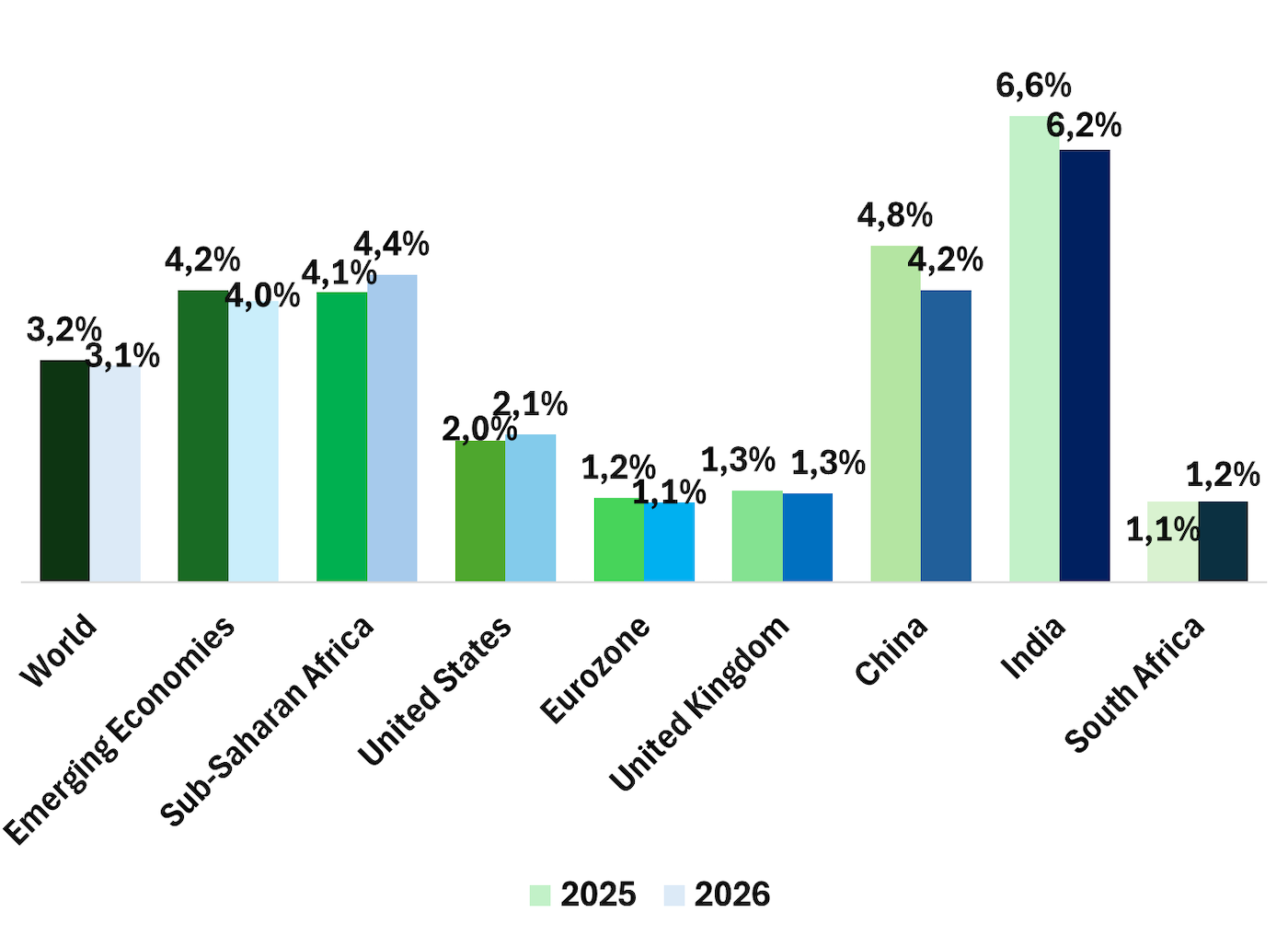
Estimated Growth for Major and Selected Economies in 2025 and Forecasts for 2026
This paints a mostly positive picture of the outlook for the domestic recycling industry in 2026. However, in addition to commodity prices, the local industry must keep an eye on the rand and if it appreciates further, environmental regulations and practices, and the broader economy, especially overseas. While a stronger rand may mean further interest rate cuts are more likely (though not as many as in 2025) as well as more stable and affordable prices for the recycling machinery of the future, a stronger currency likely also makes exports of South Africa’s manufacturing industry on which many recyclers depend less competitive in international markets. Meanwhile, the government’s draft NWMS 2026 if enacted alongside the enforcement of Extended Producer Responsibility (ERP) rules for packaging and tackling plastic pollution brings with it new rules, compliance costs and opportunities, the impact of which will have to be seen. For plastic and paper recyclers in Johannesburg it will also be interesting to see what happens with the city’s over-burdened landfills and plans for privatised waste disposal.
Besides concerns surrounding a more competitive rand, South Africa, as ever, is not an island and will be affected by any mishaps in the US and slower growing Eurozone and Chinese economies as shown in the figure above, even though a still-fast growing India is a bright spot. US data is currently all over the place and while the International Monetary Fund expects slightly faster growth in 2026, there are still concerns about the US economy’s strength, inflation, tariffs and a recession which would have global ramifications. For a still weak but slightly stronger South African economy that has still not seen desperately needed reforms this is a concern along with a continuing slowing China. Therefore, the overall outlook for 2026 for the South African recycling industry is characterised by some global uncertainty but more domestic optimism.
Happy new year from SUD Recycling and for all your recycling equipment needs please contact us on +27 11 784 8955 or email info@sudrecycling.thankmelater.co.za.
Sources: Daily Metal Price, Infrastructure News, International Monetary Fund, London Metal Exchange, Mining Bulletin, Mpact Group Ltd., OEC, Westmetall, World Integrated Trade Solution